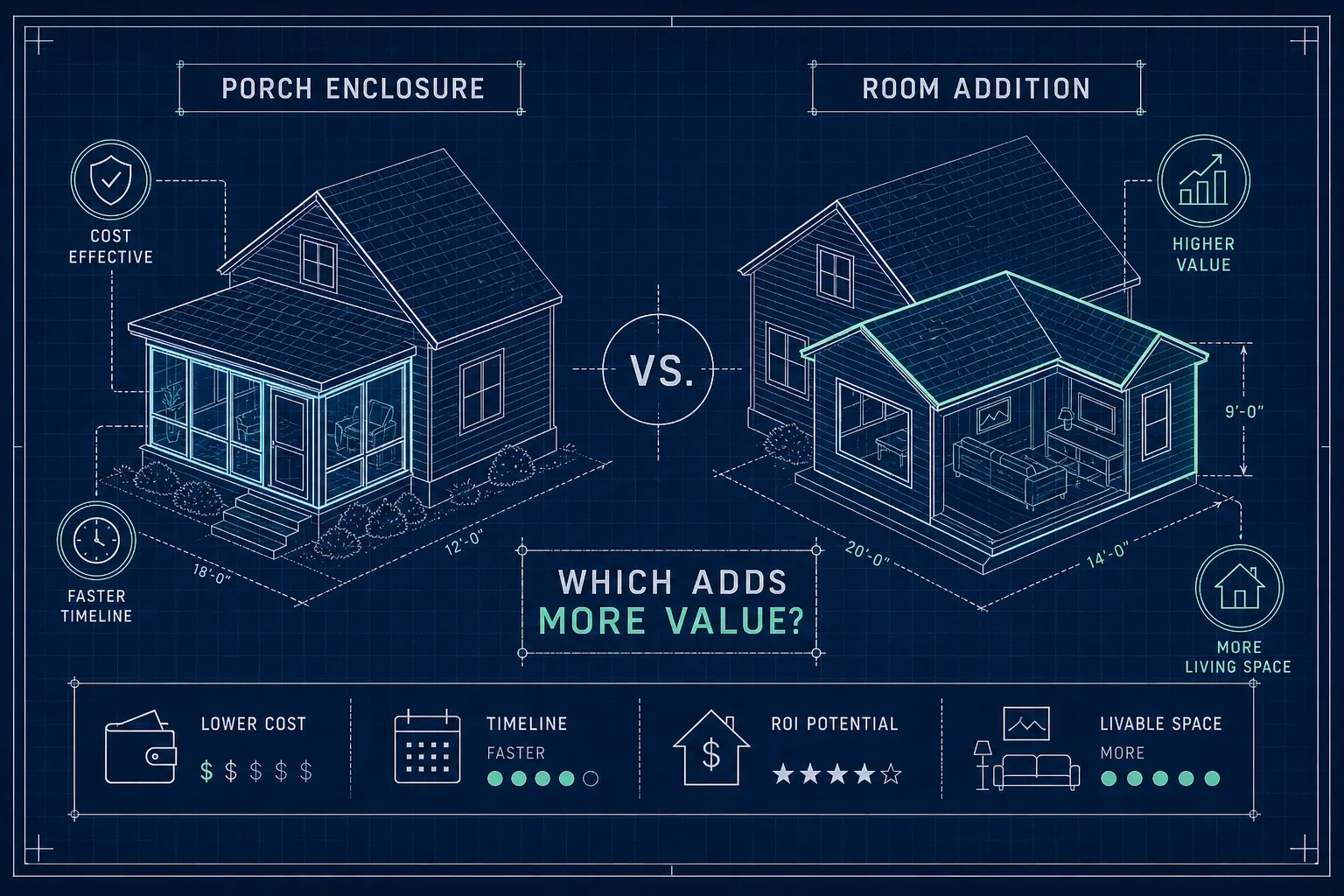
You're standing on your Gulf Coast porch, looking at the view, and asking yourself a question that comes down to real money: porch enclosure vs. room addition, which adds more home value to your property? Both options will transform how you use your home. Both require permits, contractors, and a serious budget conversation. The difference is in how those dollars translate to livable space, appraised value, and what you actually get back when you sell.
At 3H Construction, owner Ryan Hebert fields this exact question regularly from homeowners in Bay St. Louis to Ocean Springs. The short answer is that there is no universal right choice. The better project depends on your existing structure, your goals, your lot, and what comparable homes in your neighborhood are actually selling for. What this article does is lay out the real numbers so you walk into any contractor conversation prepared, not guessing.
The real cost difference between a porch enclosure and a room addition
What a porch enclosure actually costs in 2026
The national average for a sunroom or porch enclosure sits around $17,844, but that number tells only part of the story. Three-season rooms run $7,000 to $55,000 depending on size and finish, while fully conditioned four-season rooms climb to $16,000 to $70,000 before you factor in any coastal-specific upgrades. On a per-square-foot basis, three-season enclosures run $80 to $230, and four-season rooms land between $120 and $220 or more.
A screened enclosure is a different category entirely. Screening an existing porch typically costs $2,000 to $5,000, which sounds attractive until you consider the appraisal impact. Screen rooms typically recoup only about 20 to 40 percent of project cost and are usually excluded from Gross Living Area calculations, meaning they contribute far less appraised value than fully conditioned space. If resale value is part of your calculation, a screen room is rarely the right move. For Gulf Coast homeowners where heat, humidity, and hurricane exposure are real factors, the enclosure type you choose shapes both the cost and the long-term value equation.
What a full room addition costs by comparison
A full conditioned room addition, built from the ground up with a foundation, framing, insulation, and HVAC integration, runs $25,000 to $80,000 or more nationally. Most standard 200-square-foot additions land closer to $40,000 to $60,000 once all the structural components are included. That's a meaningful gap above a porch enclosure, and the price difference reflects what you're actually building: a permanent, code-compliant room that functions identically to the rest of your house.
In coastal Mississippi, expect those national baselines to stretch. Wind-load engineering fees, moisture-resistant framing, flood elevation compliance, and impact-rated materials can add 10 to 20 percent above what you'd pay in an inland market. Gulf Coast homeowners should build those regional factors into their budget from the start rather than treating them as surprises after the permit is pulled.
How appraisers and MLS listings actually treat each project
The finished square footage question for an enclosed porch vs. addition
Appraisers follow Fannie Mae guidelines for Gross Living Area (GLA), and those guidelines are specific. To count toward your home's finished square footage, a space must be fully enclosed, permanently heated and cooled by the home's central HVAC system, finished to the same quality standard as the rest of the home, and accessible from inside without stepping outside first. A three-season porch enclosure typically fails one or more of these tests.
When a space doesn't qualify as GLA, appraisers note it as a feature rather than adding it to your square footage. That distinction matters more than most homeowners realize. A 200-square-foot room counted as GLA raises your appraised value differently than a 200-square-foot enclosed porch listed as a separate amenity. The dollar-per-square-foot rate applied to GLA is much higher than the fractional rate, typically 25 to 75 percent of that rate, applied to non-conditioned space.
How MLS listings handle the gray area
Many sellers and their agents list enclosed porches separately to avoid misrepresentation. You'll see listings noting "2,300 sq. ft. + 250 sq. ft. enclosed porch," which signals to buyers and appraisers that the additional space is not conditioned living area. Buyers and comps treat that space differently, which means the value you assume you're adding may not show up the way you expect in a competitive market.
A four-season, permitted, fully HVAC-integrated enclosure can qualify as GLA, but it needs to check every box. A standalone wall unit or space heater does not satisfy the permanent heat source requirement. The enclosure needs to tie into the home's central system, meet insulation codes, and carry the right permit classification. When all of that is done correctly, the space counts. When any piece is missing, it doesn't.
ROI reality: porch enclosure vs. room addition, which adds more home value at resale?
Sunroom and porch enclosure ROI by type
Four-season sunrooms recoup approximately 50 to 70 percent of project cost at resale. Three-season rooms drop to 45 to 55 percent, and basic screen rooms land at just 20 to 40 percent. In warm Southern climates like coastal Mississippi, where outdoor living is practical for most of the year, four-season rooms consistently perform at the higher end of that range because buyers see them as genuinely usable space rather than a seasonal bonus.
There's also a speed-to-sale factor worth considering. According to National Association of Realtors lifestyle-market data, homes with sunrooms can sell 10 to 25 percent faster in outdoor-living-oriented markets. Faster sales have real financial value even when the ROI percentage isn't the highest number on the comparison sheet. If you're weighing a sunroom against sitting on the market for an extra two months, the math shifts considerably.
Room addition ROI by type
The most recent Cost vs. Value report shows that primary suite additions recoup only 18 to 32 percent of their cost at resale, making them one of the lowest-return major projects despite their high price tags. General-purpose room additions, a new bedroom, expanded living room, or flex space, land closer to 40 to 50 percent recoup. That's comparable to a solid three-season sunroom, but with the added benefit of being counted in GLA.
The key distinction is between ROI percentage and absolute dollar value added. A four-season porch enclosure can outperform expensive room additions on ROI percentage, but a well-planned room addition often adds more total dollar value because the appraiser counts it differently. Paying more to build doesn't automatically mean you get more back as a percentage, but it can mean a higher appraised value and a more competitive listing price when you sell.
Permits, codes, and coastal Mississippi requirements
What separates a habitable space from a simple enclosure
The line between a permitted porch enclosure and a fully habitable room comes down to four main factors: permanent HVAC integration tied to the home's central system, full residential-grade insulation in walls, ceiling, and floor, finished interior quality matching the rest of the home, and a building permit that reflects the intended use. Miss any of those, and the space stays in the non-habitable category regardless of how finished it looks.
A three-season enclosure can often follow a simpler permit pathway, sometimes referencing patio cover codes rather than full residential addition requirements. That simplified path comes with relaxed insulation and fenestration standards, which is exactly why it won't count toward your square footage. Habitable space requires egress compliance, energy code compliance, and structural tie-in that simple enclosures are not required to achieve.
Coastal Mississippi adds another layer
On the Gulf Coast, every addition and enclosure has to account for hurricane wind-load engineering at 140-plus mph design speeds, FEMA flood elevation rules if the property sits in a flood zone, and moisture-resistant construction built to handle salt air and sustained high humidity. In Hancock, Harrison, and Jackson counties, projects within the coastal zone also require Mississippi Department of Marine Resources (MDMR) authorization in addition to the local building permit before construction begins. That state-level coastal zone requirement applies to both project types, though applicability can vary based on parcel location and project scope.
An unpermitted enclosure in a flood zone creates serious liability and can complicate insurance claims down the road. If the project triggers the 50 percent substantial improvement rule, meaning the addition costs more than half the existing structure's market value, the entire building may need to be brought into compliance with current Base Flood Elevation requirements. These regional code layers affect both project types, but they tend to add proportionally more cost and complexity to a full room addition because of foundation and structural requirements.
- PE-stamped structural plans are required for 140-plus mph wind compliance, typically adding $1,500 to $4,000 in engineering fees depending on project scope and county requirements
- Impact-rated glazing (hurricane-rated windows and doors) is required for enclosed spaces in coastal high-wind zones under local adopted code; confirm specific requirements with your county building department
- Properties in AE or VE flood zones require a pre-construction Elevation Certificate and may prohibit habitable space below the Base Flood Elevation
- Projects within coastal zone boundaries in Hancock, Harrison, and Jackson counties require MDMR authorization before a local permit is issued
Choosing the right project for your home and goals
When a porch enclosure is the smarter move
If you already have a solid existing porch structure, your primary goal is gaining flexible living or entertaining space rather than a counted bedroom, and a four-season porch enclosure fits your budget, it often delivers the strongest value-per-dollar on the Gulf Coast. You're starting with an existing foundation and roof structure, which reduces the total construction scope significantly compared to breaking ground on a full addition. In many cases, this means the porch enclosure route is the more cost-efficient path when you don't need the space to count as GLA.
A porch enclosure is also the better choice when zoning setbacks or lot constraints make a full addition difficult to approve, or when your priority is adding appeal and selling faster rather than maximizing the square footage number on your listing. In a warm coastal market where buyers value outdoor-adjacent living space, a well-executed four-season enclosure is a genuine asset at closing.
When a room addition justifies the higher cost
If you need a fully counted bedroom for a growing family or a stronger appraisal, want to add a primary suite, or need a space that functions identically to the rest of the house in every season, a room addition is the path that achieves those goals. It's worth noting that a fully permitted, HVAC-integrated four-season sunroom that meets all GLA criteria can approach a standard addition on both appraisal value and ROI percentage. Even so, when counted GLA square footage is the specific goal, particularly for lender qualification or competitive comps in a square-footage-driven market, a full room addition is the more direct solution.
The higher upfront cost pays off differently: not always in ROI percentage, but in how lenders, appraisers, and buyers quantify what your home is worth. If your neighborhood comps are priced heavily on square footage, adding counted living area through a full addition is the move that moves the number.
Getting clarity before you commit
The honest answer for most homeowners is that the better project depends on the existing structure, the lot, neighborhood comparable sales, and what the space will actually be used for. None of those variables resolve through a blog article. They resolve through a walk-through with a contractor who knows the local codes, the flood zone maps, and what buyers in your specific neighborhood are paying for.
That's exactly why 3H Construction offers free on-site consultations. Ryan walks the property, reviews the existing layout, checks the flood zone classification for your address, and gives you a side-by-side cost and ROI comparison before any commitment is made, real numbers, not ballpark guesses. Reach out to schedule yours.
The bottom line: porch enclosure vs. room addition, which adds more home value?
Weighing a porch enclosure vs. a room addition comes down to this: enclosures cost less upfront and can deliver strong ROI, especially at the four-season level, where the space may qualify as GLA and typically recoups 50 to 70 percent at resale. Room additions cost more but earn full square footage credit, add absolute dollar value to the appraisal, and serve functional needs that most sunrooms cannot match. Neither project is universally better; the right choice is the one that fits your budget, your goals, and your home's specific situation.
In coastal Mississippi, national cost and ROI averages are a starting point, not a finish line. Flood elevation compliance, hurricane wind-load engineering, MDMR authorization requirements, and coastal-grade materials shape both projects in ways that inland comparisons don't capture. Working with a contractor who already understands those layers means you're not discovering them after the permit is submitted. Call or email 3H Construction to set up your walk-through and get a clear picture of which project makes the most sense for your home.
0 Comments